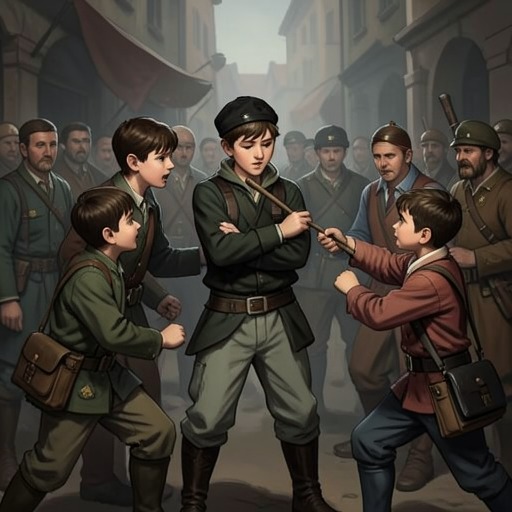
Rob stands up to protect Sistine
The Tiger RisingRob stands up to protect Sistine when he sees a group of students attack her outside the school lunchroom. The scene turns on a sharp reversal: Rob initially remains silent, but then he risks drawing the students’ attention away from Sistine and runs so they will pursue him instead. His intervention does not make them friends at once, but it changes their relationship enough that Sistine sits beside him on the bus that afternoon.
Causes and Background
At lunch, Rob sits alone on a bench in the breezeway rather than entering the lunchroom, where Norton Threemonger and Billy Threemonger are. Since his mother died, food has lost its taste for him; school meals seem even worse than his father’s cooking. He studies a drawing of the tiger, his fingers itching to carve it in wood, when shouting and the students’ excited noise signal that something is happening.
What Happens
Sistine comes through the lunchroom’s faded red double doors with her head held high, followed by a crowd of students. When one of them throws something and hits her, Rob wants to warn her to run, but says nothing. He and Sistine look at each other; she turns back toward the crowd, moving into it as if into deep water. Then she begins swinging her fists, kicking, and twirling. The students close around her until she seems to disappear. Rob stands to see better and catches sight of her crumpled pink dress and her arms still moving.
Rob calls out once, then moves closer with the tiger drawing still in his hand and shouts, “Leave her alone!” The words surprise him. The crowd turns toward him, and for a moment the scene goes quiet. Sistine tells him to go away without looking at him; her yellow hair is stuck to her forehead with sweat. A black-haired girl pushes close and shoves Rob. He repeats his demand. When the girl asks whether he will make her, the other students wait for Rob to act, as does Sistine.
Looking down, Rob sees that the object thrown at Sistine was an apple. He stares at it, then looks up at the waiting group. Instead of fighting, he runs. The students follow, and Rob drops the drawing as he races away, pumping his arms and legs. He knows what it is to be chased; this time, however, the pursuit gives him a sudden thrill because he understands that it is saving Sistine. He cannot explain why he would protect someone who hates him, but he keeps running. The bell rings before the group catches him.
Consequences and Aftermath
Because Rob has to walk from the gym to the front of the school, he is late to English class. He no longer knows where the tiger drawing has fallen. What still matters to him is the note from Mr. Phelmer in his back pocket, which proves that he will never have to return to school. The lost drawing and the note frame the episode with two different kinds of value: the image he had been holding is gone, while the prospect of leaving school remains important to him.
That evening, Sistine sits in the empty seat beside Rob on the bus home. Her dress is torn and muddied, there is a scrape down her right arm, and her hair sticks out in every direction. She looks at him with her black eyes and explains that there is nowhere else to sit because this is the last empty seat. Rob shrugs. Her choice of seat does not erase her earlier hostility, and the bus exchange is not an explicit reconciliation; nevertheless, it follows directly after his intervention and places them side by side where they had been separated by suspicion and conflict.
Significance
The event is a rescue shaped by a reversal of attention. Rob does not defeat the students or confront them physically: after first speaking up, he makes himself the object of their pursuit. The crowd’s focus shifts from Sistine to him, allowing her to escape the immediate pressure around her. His own experience of being chased becomes the means by which he recognizes what his action is accomplishing.
The tiger drawing connects the episode to Rob’s private creative attention, but it also becomes a concrete cost of acting: he drops it and cannot find it afterward. More consequentially, his conduct contradicts his established impulse to stay quiet. He speaks despite uncertainty, faces the group’s challenge, and runs while knowing they are behind him. The passage makes his motive deliberately unresolved—he cannot say why he would save Sistine, who hates him—while making the action and its effect clear. Their uneasy proximity on the bus is the immediate relational change the episode leaves behind.